Photographers that shaped the industry
EDDIE ADAMS 1933-2004 "Still photographs are the most powerful weapon in the world," - Eddie Adams This famous picture on the left is taken from Eddie Adams, a photojournalist who took photographs of politicians, celebrities and wars (he covered 13 wars in total). This photo pictured right "Murder of a Vietcong by Saignon Police Chief" is one of his most memorable taken from the Vietnam war. It shows the true brutality of war, an officer shooting a handcuffed prisoner from point blank. Framed as a mid-two shot on an average aperture f8 to capture the subject and the soldiers behind are still in focus but the background is blurry. It does not show the generals face but it shows the Vietcong's beaten face, showing that he was heavily attacked before execution. This envelopes a strong sense of verisimilitude as the general is depicted as the villain and his face is hidden, hiding his emotion and the prisoners face and emotion is bought towards the camera and the audience. |
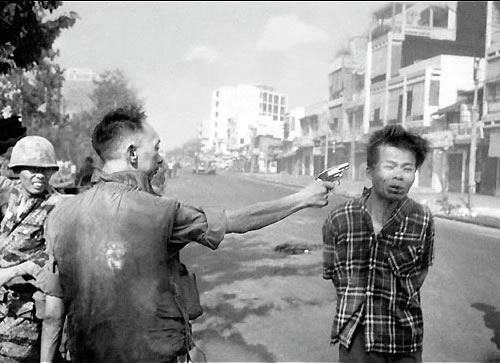 "Murder of a Vietcong by Saignon Police Chief" - 1968 |
This picture one Eddie the Pulitzer prize in 1969. This photo is a landmark in history as it changed the American public's view on the Vietnam war. The given title to this picture is "the photograph that ended a war but ruined a life ring true for General Nguyen Ngoc Loan (he is the man pictured pulling the trigger). He was transferred to the United States after an Australian hospital refused to treat him, and the Americans started a campaign to get him deported, this photograph will forever haunt him and Adams apologised to the general stating "The general killed the Vietcong, I killed the general with my camera. The full context is not given in this photograph though, which is also the case many other photos. The man being shot was captain of a Vietcong revenge squad that executed dozens of civilians earlier that day, but General Loan is the pictured villain in this photo. This truly depicts the power of photography and how it can instantly effect the world and effect individual's lives. Linked resource here.
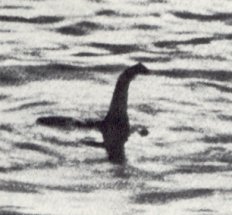 "Loch Ness Monster" - 1934 | IAN WETHERELL The photo pictured to the right is commonly known as the sighted "Lock Ness Monster" but is also known at "The Surgeons Photo", one of the biggest hoaxes ever. The was already a legendary myth that a monster inhabited the Loch Ness Lake in Scotland, dating back to 565 C.E. But it was this photograph that really increased the speculation towards the myth, apparently it started off underwater searches and bought in a huge tourist attraction that boosted the economy by several millions. This is shot on a wrong aperture and shutter speed to make the photo blurry, out of focus and grainy so that it make the figure appear more mysterious. |
Wetherell's dad Marmaduke was a hunter and was hired by The Daily Mail to find this monster. But Marmaduke and his son Ian decided to fake it using a toby submarine and wood putty. Ian took this photograph but they decided to give the credit to Robert Kenneth Wilson, who was a trusted figure in his community, just to add some reliability to this story. This really backs up the question "is anything true when behind a camera?" and fuels the statement "the camera never lies, but people do". Resource found here.
ROBERT CAPA 1913 - 1954 This is one of the most iconic war photographs, depicting the landing on the Omaha beaches on 6th June 1944 in Normandy on D-Day. Capa escaped the boats with the first waves of infantry and was under heavy fire, he dived for cover and shot all the film on his camera. Robert Capa famously stated "If your pictures aren't good enough, you aren't close enough." This statement really shines through on the photo pictures right, as the only way you can demonstrate the fear and emotion is by being their in person. He would have had no time setting his camera to capture in the right aperture or shutter speed which is shown in the blurriness. | 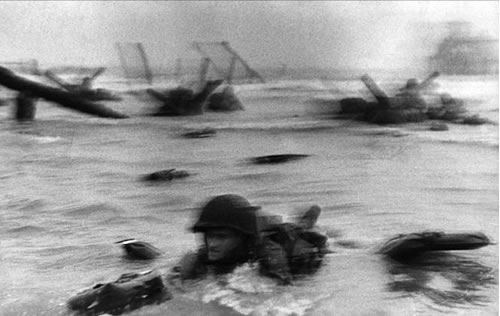 "Omaha Beach, Normandy, France" - 1944 |
The blurry photograph showed that he was not too worried about capturing the best of pictures because it was what he taking the picture of that tell the story. The blurriness shows the amount of movement coming from Capa as he runs for cover to save his life, luckily Capa did escape. Of the four rolls of film Capa took of the D-Day landing, all but 11 exposures were ruined by an under experienced lab assistant, who melted the film in his rush to develop it. So we will never get to witness what other photographs he managed to capture on the day he landed on the beaches, one of the most memorable moments in World War 2. However the exposures that did survive were affected by the lab assistant and were given this out of focus look. It was this that inspired Steven Spielberg in Saving Private Ryan, he stripped the coating from is camera lens to mimic the style captured by Capa to create the sense of realism from that horrific day.
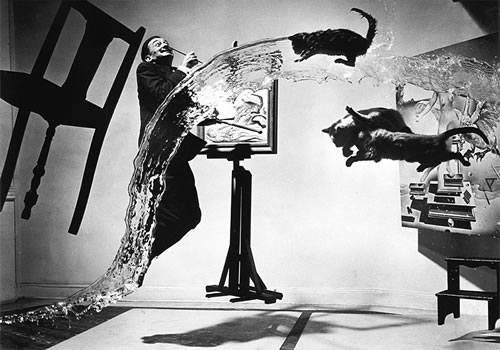 "Dalí Atomicus" - 1948 | Philippe Halsman 1906 - 1979 Philippe Halsman is the Salvador Dali of photography. He states that in photography the act of leaping revealed his subjects' true selves. This is apparent in the photo pictured to the right 'Dali Atomicus'. With Dali's Leda Atomica pictured to the right behind the flying cats. To create this photograph it took 28 jumps in 6 hours and a lot of assistant throwing cats across a room and throwing buckets of water in the air, in order to get the correct exposure. It would have been shot on a very smal focused aperture for each photo in this image, roughly f3-4, and the shutter speed would be set very high at roughly 1/2000 to capture the movement and freeze the water crisply. |
- John Bird
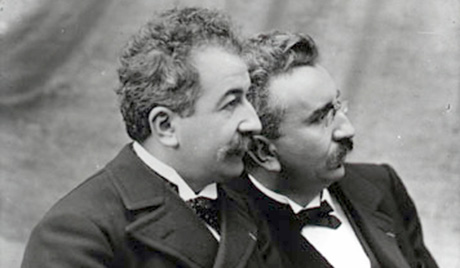
 Because of the constraints of technology, 'real' events were often re- staged for the cameras in a studio, especially if the events took place in distant countries. Audiences were, for a while, quite accepting of these 're-creations', but during the 1920's rapid development of filming techniques by pioneers like the American Robert Flaherty and the agit-prop filmmakers in the Soviet Union saw the emergence of much more sophisticated films about contemporary life across the globe. These filmmakers recorded on location, but even they had to 'stage' certain events to record them effectively. see Eisensein, Battleship Potemkin 1925 also Vertov. Man with a movie camera 1929. The earliest forms of documentary can be seen in early cinema (circa 1900) in the work of the Lumiere bros., see workers leaving the Lumiere factory or men demolishing a wall.
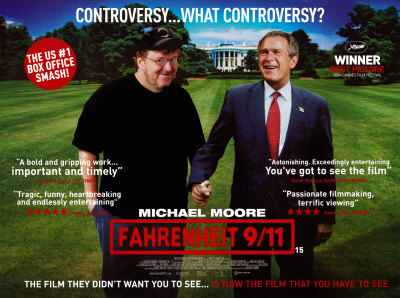
The television took over. Since the 1950s, whilst occasional feature-length documentaries have continued to be shown in cinemas, most documentary 'films' have been made for television and from the 1980's most non-broadcast, non-fiction material has been shot on video although the recent success of Michael Moore’s Bowling for Columbine and Fahrenheit 911 shows there are still large audiences for documentary in the cinema context. The move to television had a number of effects. Documentaries became part of the viewing schedule, both as programmes in their own right, and as 'inserts' or items in magazine and current affairs programmes. They continued to have an educative function, (see 7up series Apted 1964 ) which was now inscribed in the BBC Charter and the requirements for ITV franchises, but they could not be propagandist (except when forming part of a Party Political Broadcast).
 Documentary as truth? Critical approaches to documentary practice. The status of documentary as 'truth' has led to a range of critical positions attempting to theorise documentary practice. One of the most influential approaches has been that developed by the American academic Bill Nichols (1991), who suggested the following 'modes' of documentary: see here.
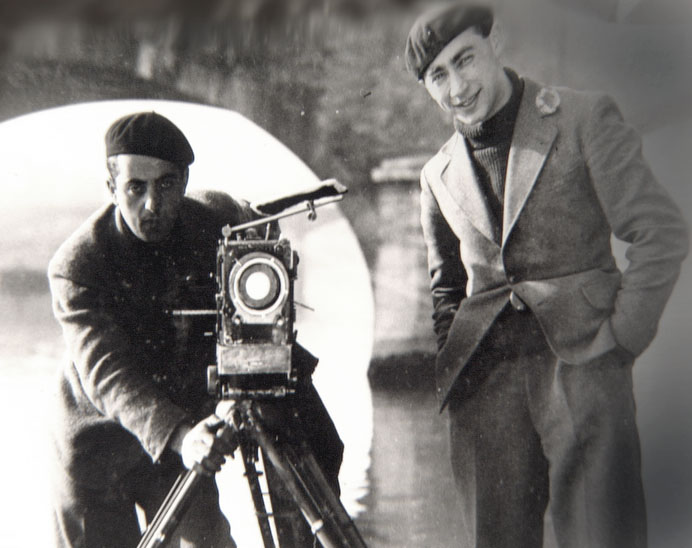
 The reflexive mode problematises what we are seeing by acknowledging the masses. In a sense this is the direct opposite of the expository and observational modes, both of which attempt to convince us that we are not watching a carefully constructed documentary but rather have access to a 'window on the world'. Man with a Movie Camera (1929), Dziga Vertov's most famous work, is an excellent example of the reflexive mode. It is an ebullient and invigorating city tour, a mix of Moscow, Kiev and Riga, in which the hero, is the eponymous observer of events. Vertov's self-reflexivity (a modernist characteristic) consists of a number of techniques which draw attention to themselves. Vertov is even self-reflexive about the cinema experience: his film opens by showing an audience entering the theatre and watching the film begin.Other sequences emphasise the constructed nature of the film by: • showing the cameraman filming events we see on the screen, sometimes as a reflection is a window or using eyeline match editing; • inanimate objects are animated using stop-motion photography, • an eye is superimposed on the camera's lens (the kino-eye indeed). While the interactive mode emphasises the relationship between the documentary maker and her/his subject, the reflexive mode is more concerned with the encounter between the documentary text and its audience.There is, of course, a danger that by drawing too much attention to its own mode of construction, a documentary may cause the audience to lose sight of its subject; the medium can obscure the message. That said, at least this mode makes the clear statement that representing the world cannot be other than problematic, and that to suggest otherwise is a form of lie. | John Grierson was heavily influenced by ideas about the educative possibilities of documentary and he argued strongly for support of both production and distribution of films for the education of audiences as a contribution to the development of an informed citizenry. Films like Industrial Britain (1931), Song of Ceylon (1934), Housing Problems (1935) Coal Face (1935) etc. Introduced the idea of documentary as an educational tool. Grierson’s most famous doc, Night Mail (1936) focuses on the journey of a mail train, educating people. They also, coincidentally, helped practitioners to develop filming skills and to experiment with film form. The documentary films of the 1930's were seen across the world as Britain's contribution to 'world cinema' and the development of cinema as an art form.
  Their place on prime-time television raised the question of entertainment. This was particularly true of ITV schedules, which saw the success of 'investigative' programmes like World in Action and This Week, that showed documentaries to regular audiences of 7 or 8 million from the 1960s through to the early 1990s. The more shocking, sensational or emotional the subject matter, the more attention these programmes received and the larger the audience. Television continued the tradition of 'authored' documentaries associated with Flaherty and Jennings, but occasionally this caused problems with accusations of bias. Some reporters (e.g. John Pilger) and some producer/directors (e.g. Roger Graef) became well-known.
An 'observational' documentary does not show 'real people', it shows 'social actors'? The observational mode describes what is more commonly known as 'fly-on-the-wall' documentary. This is in turn has been taken as more general term referring to cinema vérité (cinema 'truth') and 'Direct Cinema'. Direct cinema (USA) & Cinema Verite (France) In practice these were two quite distinct movements, one in France and the other in America at the end of the 1950's and the start of the 1960's. The French approach in fact had much more in common with the interactive mode set out below, with its attempt to provoke and stimulate the 'real world'. 'Cinema truth' is a translation of 'Kino Pravda', the newsreel established by Dziga Vertov. Direct Cinema made the claim to be purely observational.
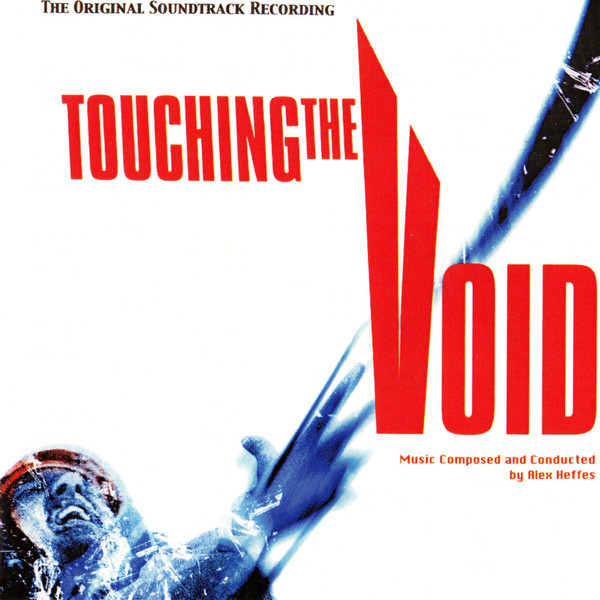 Let's get started on what all this means to us as a company. We are inspired by investigative documentaries, because we believe the form delivers impacting subject matter to the audience through reconstructed, and real events, which the audience can relate to. Therefore excluding biased approaches, and bringing the audience to the heart of the matter by including acting, real events, interviews and participatory involvement. Thereby bringing the meaning to the heart of the filmmaker as well, this in turn is subconsciously passed onto the audience, because then it makes them believe what we are witnessing is true, so therefore being educational. In recent years the cinematic documentary has made a limited comeback with the success of films by Michael Moore, see `Bowling for Columbine’ and Fahrenheit 911. See also Touching the Void. Audience' desire for ‘reality’ and improved marketing across to DVD are factors in this revival. Although it should not be forgotten that early cinema audiences had similar desires to watch movies that represented the real. (See Lumiere bros, early cinema.) Over a century has elapsed since the first documentaries were produced on film for cinema and the debates around documentary truth and realism are still basically the same today. - Toby Shepherd |
Industry
Vice Vice is a New York magazine dedicated to international arts and culture, their YouTube channel has over 446,500 subscribers and over 75,000,000 views so they are quite a prolific media industry. Their channel mainly consists of documentaries that their employees go out and film, all Vice documentaries conform to a certain style. They are all human interest stories of the extreme nature and habits of life i.e. the scariest, the weirdest, the most bizarre aspects of the world. So they have a very set marketing strategy and a target audience, the interviewees (when we see them) are all of the age between 21-29 (approximately) so their audience is around the ages of the presenters. |
 |
Examples of Vice documentaries that reflect human interest are "World's Scariest Drug (Scopolamine)", "Interview with a Cannibal", "Inside North Korea" (an amazing documentary where they manage to get inside North Korea and explore its surreal communist laws). They explore parts of the world that are not usually exposed, like the suicide forest next to mount Fiji where people go to commit suicide. They are mainly expository documentaries and some of them are also performative and participatory as an example of one of them is when the presenter goes to experience a cult in Russia first hand and lives with them and becomes one of them and meets their Messiah.
Our documentary idea with the Superheroes is one that could fit to the style of Vice documentaries as they have a UK branch we could pitch our idea to them, we fit their age range and their target audience and this idea is that of human interest. We will try to construct our style to that of Vice's to see if we can get out there with our project and sell it to people and ultimately make money off of it.
- John Bird
