NEXT TO DO- Discuss Bill Eppridge - analysing his history and context, analysis of his photos and state my inspiration and link to 'Life'.
Hans Wild - Shock Value
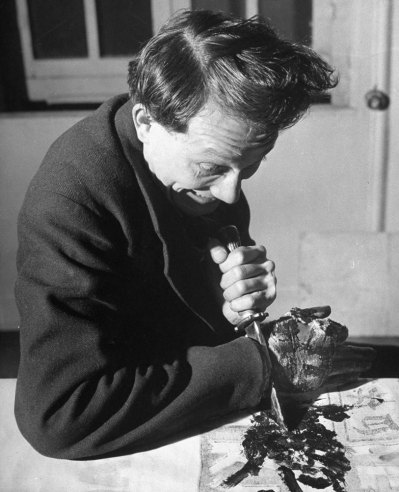 It creates an emotional response from the audience as it horrifies straight away it creates a response of disgust from the subject of the cutting and the psychotic face of the primary. It also fits into the category of surreal photo-essay document. I don't aspire to create surrealism in photography except when I use photo manipulation; I take my inspiration from Salvador Dali's work and make my own photoshop surrealism. | Hans Wild (1912-1969) is a photographer who worked for Life magazine (mention in my photo essay). He worked in America, France and Italy for assignments with Life Magazine. The photography from Hans that interests me is his 'Shock Value' work on piece is pictured right. It has many attributes that connote good photo journalism: Shock and expectation, the sole fact he is skinning his hand and attempting to cut it off is quite horrific, it is taken on quite a low aperture of about f.4.0-5.6 as the focus is all on the primary subject but the background is nicely blurred. 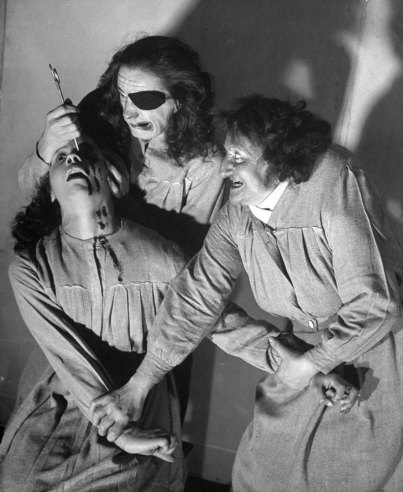 |
The Facebook Problem
When considering how to conduct my photo essay and how I was to go about the style I wanted to convey in it I researched many photographers I read through Martin Parr's blog. One of the issues he raised which I feel is a very valid point with todays media and contemporary photography. The issue is what Parr refers to as the 'Facebook Problem' which is where you go to a crowded vicinity, like a festival or a carnival etc, when you point your camera people start posing and requesting pictures. This is slowly creating a creeping effect of the loss of truth in photos which already is an argued theory "is anything truthful when on camera". But now with this 'Facebook Problem' more and more photographs are becoming staged as Parr states "This problem gets worse when people are younger, for once you get into middle age the backdrop activity of constantly shooting everyone, everywhere diminishes. Young people need to fill their Facebook pages with ever more photos of them having a good time, with virtually everybody they know."
So when reading through Martin Parr's blog and the 'Facebook Problem' I wanted to create truth through my photography and create a sense of realism within. By doing this I will take inspiration from Henri-Cartier-Bresson and how he creates realism and natural photography. Having the subjects face away from the camera so that it does not look staged, everything behind a camera can still be argued to be staged but when a subject is not facing the camera it shows they are getting on with their everyday lives which is what I want to emulate. | 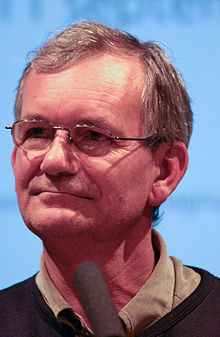 Martin Parr 'The Facebook Problem". |
James Ravilious - Rural Photography
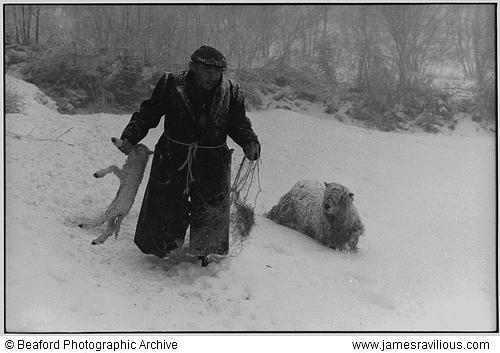
This is a wonderful shot of a man rescuing a lamb from a blizzard in Devon 1978. However how it is shot and framed can misinform the viewer, it appears that the man in shot is taking this lamb away from its family for food, until further research I found out that he was actually saving it from the blizzard. He is framed nicely in the centre to the left to give space to show the older sheep and gives a sense of loneliness and isolation, surrounded by acres of pure white snow. It is taken on a med-high aperture to capture the crispness of the man and the trees, roughly f14-16. His motion appears natural as he is not facing the camera there is a strong sense of true verisimilitude in this photo shown in his emotion and body language in the shot, looking beyond the camera to a place we cannot see (the abyss) as his body drags him forward. I would like to use this style in my photo essay, having the subject looking beyond the camera to create a sense of realism and truth in the image. |
 |
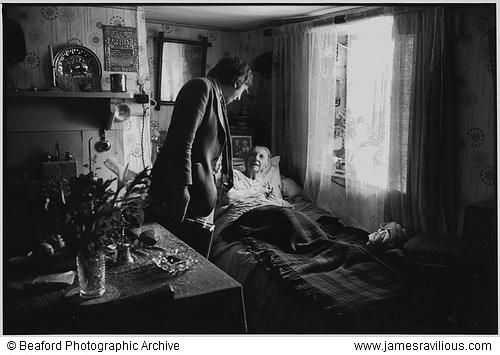 | Much like the photo above I aspire to utilise the technique having the subjects facing away from the camera in their natural working environment making it appear as the camera is not on the site with them. The body language and the framing of the shot gives the doctor a powerful presence as he looms over the old lady as she stares up at him soulfully. It applies to the rule of thirds applies to this as the out of focus plant demonstrates the aperture setting to the left (set to about f.5.0 to blur the foreground and capture the main subject in the middle) and centres the subject with the light shining through the window to create the dark looming effect on the back of the doctor. |
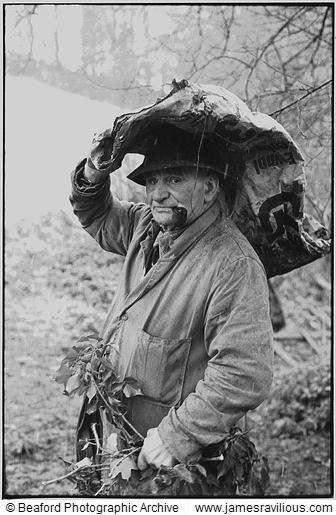
This is my favourite photo of James' portfolio, showing a man sheltering himself from the rain with a sack as he brings ivy for his sheep. The low shutter speed blurs the rain and the only droplets you can see are shown by the darkness of his hat. The aperture is set very low as the background trees are slightly blurred and the far background is totally unrecognisable, roughly f3-4. It is framed perfectly giving ample headspace to show the sack above his head and capturing the background tightly around him; setting a sense of isolation much like the photo above with the lamb. However it does appear staged as he stares right into the camera, but it captures the emotion in his face wonderfully. The background appears slightly overexposed, making it apparent it may be snowing. |
 |
Yvonne Davies - Rural Working Environment
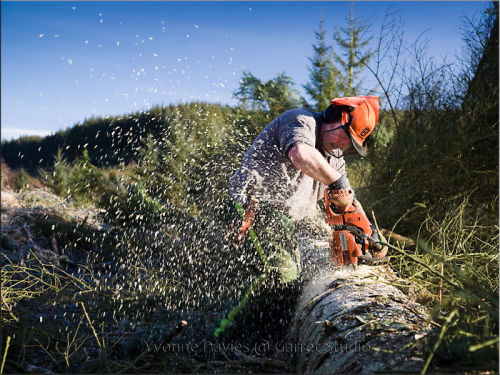 | This fantastic image to the left is one of Yvonne Davies' it is captured at such a high shutter speed of approximately 1/2000 to capture the sharp and quick movement of the shreds of wood flying away. This photo does not seem staged as the subject is facing away from the camera as he works to emphasise natural working environment. Link to gallery: http://www.yvonnedaviesphotography.co.uk/section469775_394950.html |
Vivian Maeir - Natural Photography
x This is a wonderful image to the right, one of the many from Vivian Maeir, it shows so much action and emotion in the scene yet, leaves so much untold. Is the police man manhandling the woman or is the woman being aggressive to the officer? It could even provoke a sense of desperation from the woman, she could be imploring for help from the officer as he calms her down. I really aspire to photography that creates emotion yet leaves so much untold. The aperture is set at about an average f10-14 because the image only start to become soft and blurred when it reaches the man walking away. I doubt there is a huge amount of movement so the shutter speed wouldn't need to be set too high to capture everything crisply. | 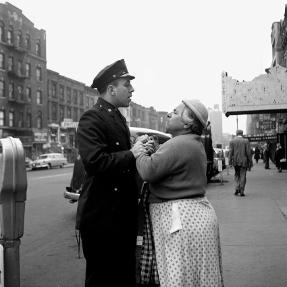 Link to gallery: |
I have taken inspiration from Yvonne Davies and her rural life photography. She has gone across Northumberland taking photos of people in their traditional rural working lifestyles. Her photography has been in numerous art exhibitions; mainly Northern i.e. Sunderland, Newcastle and some in London. I stumbled across this photographer when I was researching different rural photographers along with Vivian Maier a photographer born in New York, who's work consists mainly of everyday life on the streets. Both these photographers inspired me to go out and find people during everyday working life because, coming from a working class family, I feel they should be celebrated. I also looked into other rural photographers like James Ravilious'. I wanted to take a lot of inspiration from the classic Henri Cartier Bresson's unprovoked natural photography where the subjects would not face the camera to annihilate any sense of staged photography as they went about their lives.
Yvonne Davies website is linked: http://www.yvonnedaviesphotography.co.uk/
along with Vivian Maier's site: http://www.vivianmaier.com/
To view my photoshop work through Flickr SLiDR click here.
